

CPA or Challenging Behaviour?

Sam Brown • August 23, 2023

CPA or Challenging Behaviour? The differences and similarities

Child to Parent Abuse (CPA) is a form of domestic abuse that unfortunately isn’t always given the attention it needs. Forms of abuse such as intimate partner abuse and parent to child abuse tend to be focused on far more seriously than CPA. This then leads to misconceptions and a general lack of understanding regarding what CPA is. It is important to note that knowledge of this particular type of abuse is in its infancy. This makes it difficult for many people to pinpoint the difference between CPA and the typical challenging behaviours that most children are expected to display at some point in time. It is also important to note that there are various issues that a child could be going through that add further complexity when it comes to being a parent.


 CPA comes in an array of different forms; verbal, physical, emotional, financial, coercion & control, digital and sexual. When offering support to parents and caregivers, we look at a variety of factors, such as the frequency and intensity of incidents.


97% of the parents we support tell us that they have had to change their routine and lifestyles to reduce the risk of abusive behaviour occurring. Parents feel like they are walking on eggshells around their child, living in constant fear of an incident of abuse occurring. CPA leads to parents feeling isolated from loved ones.


Of the working parents we support, 74% have been forced to either leave work or reduce their hours. Parents can be subjected to daily or weekly physical attacks, intimidation and verbal abuse. This often leads to multiple calls for help to both the police and professionals who work within the family sector.


We understand that a child’s challenging behaviour can be very difficult and often unpleasant for a parent to deal with. However, it is pivotal that we don’t confuse CPA with challenging behaviour that is often common in children and adolescents.


If you are a parent or caregiver who is struggling as a result of your child’s challenging behaviour, there are a variety of services out there who can provide you with the necessary support. We do all that we can to help parents, but only ones who are strictly experiencing abuse from their child, not challenging behaviour.


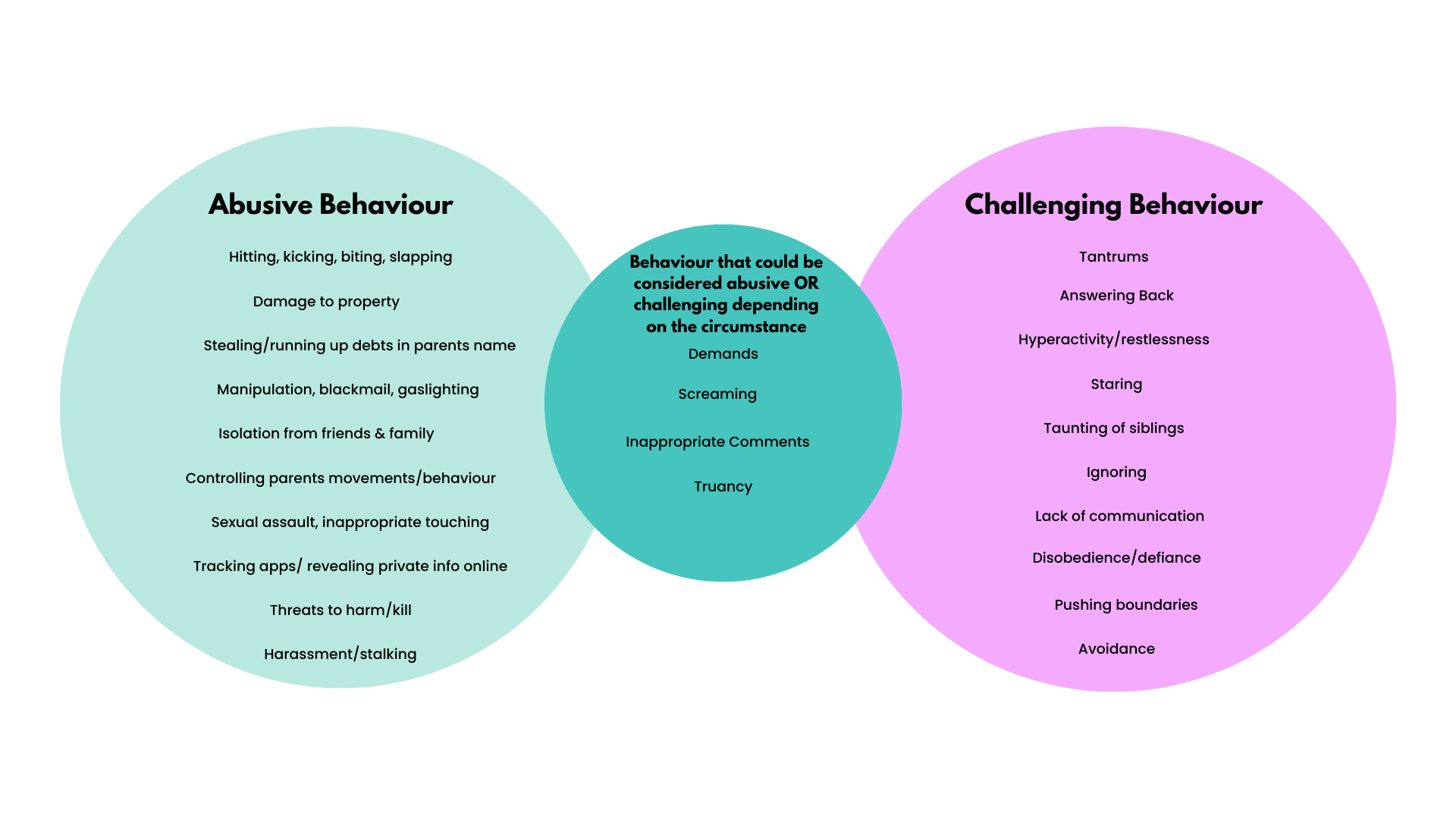
Below is a diagram with some examples of abusive behaviour, challenging behaviour and behaviour that could be abusive OR challenging depending on the particular circumstance. It is important to note that this diagram isn’t exhaustive, this is a very light touch overview of the difference between what we consider challenging and abusive. We hope that this has provided you with an overview of the key differences between the two types of behaviour, and encourage you to get in touch with us if there is any further information you require.

By PEGS Admin March 27, 2026
Service Shoutout: A Better Tomorrow 
By PEGS Admin March 24, 2026
One of the things we hear most often at PEGS is: “They don’t hit me… but they destroy the house.” A door kicked through. A phone smashed. A hole in the wall. Personal belongings ripped up or thrown outside. Furniture overturned. Glass shattered. And almost always, the parent follows it with, “I don’t know if this counts.” It does. In our work, 91% of the parents we support tell us that their property has been damaged or destroyed as part of their child’s behaviour. That’s not a one-off loss of temper. That’s a pattern. And patterns matter. It’s rarely about the object When something gets broken in this context, it is rarely random. Parents say things like: “He knows exactly what to break.” “It’s always something important to me.” “When the door goes, I know it’s about control.” Property damage in Child to Parent Abuse is often about power. It can be a way of saying: I can reach you. I can frighten you. Nothing here is safe. You can’t stop me. Over time, it changes how parents live in their own homes. They hide things. They replace items with cheaper versions. They stop putting pictures on walls. They choose their words carefully. They walk on eggshells. It isn’t “just stuff”. It’s about intimidation, control and fear. The impact most people don’t see There is the obvious damage - the broken door, the smashed screen. But what often goes unseen is everything that comes with it. The financial pressure can be relentless. Replacing phones. Repairing walls. Fixing locks. Some parents go into debt. Others live with damage because they simply can’t afford to fix it. For families in rented accommodation, there is another layer of fear. We have spoken to parents who are terrified of eviction because of the state of their home. “I dread the landlord inspection more than the arguments.” There are safety risks too. Items thrown in anger don’t always land where they were intended. Siblings witness it. Younger children absorb it. Pets hide. And then there is the emotional toll. Parents describe the dread - the constant waiting for the next crash or bang. The way their body stays tense. The shame of not telling anyone what’s happening. The fear of being blamed. “It’s the anticipation. Listening for footsteps. Wondering what will go next.” When your home stops feeling safe, it affects everything. Why it gets minimised Property damage is often dismissed as “normal teenage anger” or “behavioural issues”. Parents are told they need stronger boundaries, better consequences, and different parenting strategies. But when property damage forms part of a pattern of intimidation, threats or emotional harm, it is not simply behaviour. It is part of Child to Parent Abuse. If we ignore it because it hasn’t yet crossed a criminal threshold, we miss the opportunity to intervene early. What might help The first step is recognising that this matters. If things are being broken in a way that feels frightening, targeted or controlling, trust that instinct. Safety planning can help - thinking about safe spaces, about who you could contact if things escalate, about reducing immediate risks where possible. Reducing isolation matters too. Shame thrives in silence. Speaking to someone who understands Child to Parent Abuse can shift that sense of being alone with it. Professionals also need to recognise property damage for what it can represent. It isn’t always about anger management. Sometimes it is about power, and that requires a different response. At PEGS, we believe parents deserve to feel safe in their own homes. If your belongings are being destroyed and it feels bigger than “just stuff”, you are not overreacting. You are responding to harm.  And you deserve support that understands that.
By PEGS Admin March 22, 2026
Six Years of PEGS: Reflection, Growth and Looking Ahead